Scope
- Identify the workflow where manual effort is high and rules are fuzzy
- Map the systems, data, and messy edges the agent has to handle
- Write down what the agent can read, write, and call before any code lands
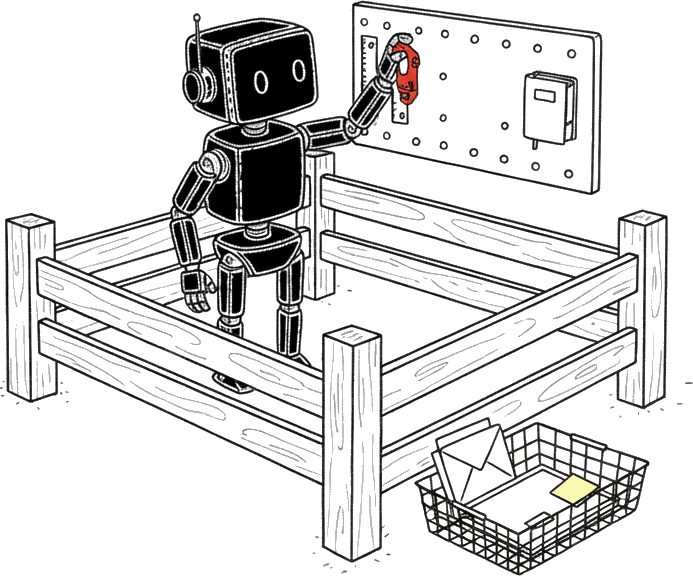
An agent without limits is a liability. We build systems that read messy inputs, use approved tools, and produce auditable outcomes — inside a sandbox you control, against permissions you write down before anything ships.
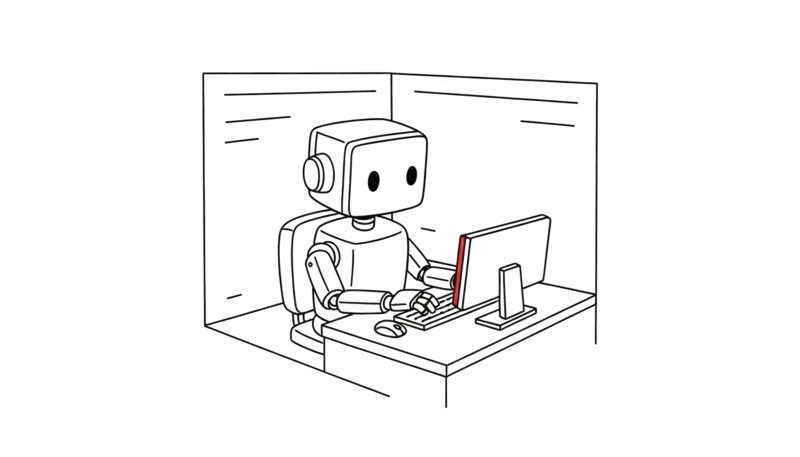
The work depends on reading messy inputs, weighing context, and choosing the next move. Hard-coded logic gives up before it starts.
Specialists spend their day stitching context across tools because no single system knows the whole picture, and the people who do become the bottleneck.
Pointing a model at real systems with broad permissions is a non-starter for serious teams. The experiments stall before they ship.
The structure surfaces boundaries early and earns trust before any code lands in production. Each phase has a defined output you can hold us to.
Mission, scope, operational boundaries
Briefs, prior runs, internal records
Conditions the work must meet to be signed off
Trace every tool call to see the steps the agent took.

Allow-listed domains
Isolated from the host
Scoped to this workflow
Validated artefacts handed back to the person
A private session where we surface the workflow worth automating, score it against the feasibility scorecard, and decide together whether it is worth a pilot. If you have specific questions about systems, security, or fit, get in touch first.
The best first pilots usually involve repeated manual work, multiple systems, messy inputs, and a clear business payoff if execution becomes faster or more consistent.
No, but existing APIs and structured data help. Part of the audit is understanding what interfaces already exist and where wrappers or purpose-built tools are needed.
Yes. Workflows can be designed for read-only research, draft generation, approval before execution, or direct writes for lower-risk actions.
The systems are designed around explicit permissions, approved tools, bounded execution environments, and review paths. The goal is controlled access to a specific workflow, not unrestricted access to everything.
No. The strongest fit is usually a technically mature team with real workflow complexity, whether that sits in a mid-market company, a product organization, or an operations-heavy business.
The audit is the low-risk first step. It identifies one strong workflow candidate, maps the relevant systems and safety boundaries, and defines whether a pilot is worth building before anyone commits to implementation.
We unlock €50,000+ of measurable annual value across your top three workflows. If we don’t, I hand you €500 and walk.