Ninety minutes to know whether AI can practically help your business.

One person, a fleet of AI agents — that pattern enters a company one workflow at a time. The workshop is where you pick that first workflow — on site, with the people who actually run the work. You leave with a named candidate ready to scope, or with a clear “not yet” and reasoning you can act on.

The first move, not a fit assessment.

The workshop is built backwards from a single decision: which workflow inside your company should run this way first? It is small enough to make in an afternoon, and it is the move that starts the compounding. Every session ends with one of two answers, and both are useful.

01A named candidate workflow, ranked and costed, ready to scope as a controlled pilot — and a first person inside your company who has run the exercise.
02Or a clear 'not yet' verdict with reasoning — so you stop spending attention on AI noise that does not apply to you.

The compounding asset of the next decade is the in-house capability to run this pattern, built one workflow at a time, on work the company already understands. The workshop is where that decision gets made — or where you learn, honestly, that nothing is ready yet.

One company. Two to six people. Mostly leadership.

The workshop runs inside a single company at a time, with the people who can actually decide and the people whose work would change. Mixed-company cohorts dilute the signal — single-company rooms produce real answers.

01At least one person who can authorize a pilot — CEO, COO, CFO, or equivalent.
02One or two commercial or operational leaders whose teams hold the candidate workflows.
03Optionally one engineering lead. Capped at one — more pulls the room into implementation detail too early.
04A company that already runs on multiple internal systems, with at least one workflow currently bridged by human effort.

Frame, surface, score, cost, sketch, offer.

01
Frame

Open with the dual-outcome promise. Surface the room's current beliefs about AI in one quick round, so the starting point is honest.

02
Surface

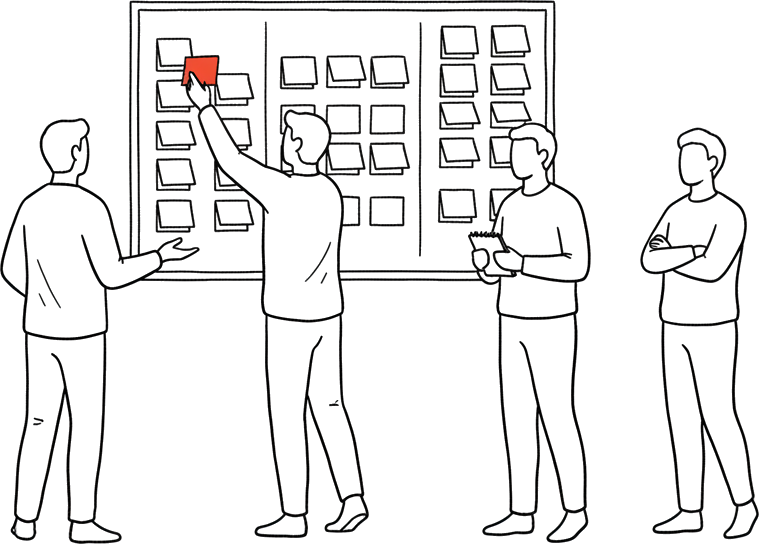
Each attendee presents the time-eating, judgment-heavy tasks they brought from a 15-minute pre-work brief. Tasks go on the board in their own words.

03
Score

Walk a five-dimension rubric out loud — frequency, annual cost, input readability, system accessibility, error containment. A ranked shortlist emerges.

04
Cost

On the top one or two tasks, run the math live: hours times runs times people times loaded rate times working weeks. Real numbers, on the board.

05
Sketch

Draw what a pilot would actually do for the top task — inputs, systems touched, what the agent does, what humans still do, rough timeline.

06
Offer

The pilot offer, or a clear non-fit recommendation. One CTA: book the scoping follow-up, or part company honestly.

In person, on site, ninety minutes.

The workshop is delivered in person, on site at your offices. Ninety minutes, fixed. Held to time so the room knows the offer is coming.

01Duration: 90 minutes.
02Format: in person, single company.
03Location: on site at your offices.
04Materials: printed workbook per attendee, whiteboard or flip chart, the agenda above.
05Pre-work: 15 minutes per attendee, sent 3-5 days before. No deck, no IT consultation.

What you walk away with.

Two artifacts per session, both designed to outlive the 90 minutes and to be forwardable inside the company.

01A printed workbook with your top tasks scored, ranked, and costed in your own numbers.
02A same-day email with the typed-up shortlist, the cost-of-inaction math, and Allan's honest commentary on each top task.
03If a pilot fits: a calendared 60-minute scoping meeting with a fixed-price pilot proposal to follow.
04If a pilot does not fit: a clear, written recommendation for what would actually help — a process fix, conventional software, or a different workflow.

Ready to find out, with evidence?

Tell us a little about your company and the people you would bring. Allan reviews each request manually and replies within a few working days.

Book the Workshop

Find the workflow that should be your first controlled AI pilot.

Start with one high-value process where manual coordination is slowing the business down.